

Frequently asked questions - FAQ (European Partnerships in Health)
General questions│Documentsto be completed - Mandatory annexes│Applicantandco-applicants│Number
General questions
Theme of the project Allowed and excluded call topics can be found in the international "Call text" document of the relevant European Health Partnerships calls. In case of any uncertainties, it is recommended to consult the project consortium coordinator as well as other partners or to contact the call secretariat/coordinator of the respective partnership directly. Contact details for the call secretariat can be found in the international document "Call text". When it comes to expertise and whether a project topic falls within the scope of the call, we always refer to the international level (the secretariat of the relevant call), as that is where such matters are assessed and reviewed. It is certainly important to ensure that the project topic does not fall within any of the listed excluded areas. Future topics are currently under discussion among representatives of the participating funding organizations and agencies. At this time, no future topics can be publicly announced. You can view the Strategic Research and Innovation Agenda (SRIA): Strategic Research & Innovation Agenda for Personalised Medicine – European Partnership for Personalised Medicine – EP PerMed), which sets out the partnership’s objectives, expected outcomes, research priorities and activities, and the overall direction of the partnership. The SRIA provides an overview of potential topics for future calls. Where to place our research topic? Is our project relevant to the call?Expertise and whether the project topic falls within the scope of the call for proposals?What will be the future call topics for the PerMed partnership?
Start of the project The possible start date for the project is defined by the international terms and conditions set forth in the “Call Text” and must comply with the statutory deadlines specified in the national document Conditions for an applicant’s participation in the call. The start and end dates of the project depend on the agreement of the entire project consortium and must be identical. If this is not agreed upon during the first round of the call, it may be adjusted during the second round of the call, provided the project advances to that stage.What is the recommended start and end of the project?
Number of projects submitted Yes, an organization or institution may submit more than one project in response to a call for proposals, provided that this is not restricted by the specific terms of the call. Not applicable – proposals submitted under EU partnerships are not counted toward the AZV ČR limit. Can an organisation/institution submit two projects to the call?In standard AZV ČR competitions, the number of proposals that a single person may submit as a proposer or co-proposer in a given yearČR limited to two. Do proposals submitted as part of an EU partnership count toward this limit, or does this limit not apply to EU partnership proposals?
List of participating countries in the EP call A list of participating countries and budget allocations is available for each call on the AZV ČR website, specifically in the national document “Conditions for the Participation of Czech Applicants in the Call”—always in the final chapter or on the official website of the relevant European Programme for the call in question.Where can I find information about the countries participating in the EP call and their budget allocations for individual consortium partners?
Funding organizations The national funding organization is the Ministry of Health ČR. Include MZCR as an acronym in the pre-proposal and full proposal. The correct name is the Czech Health Research Council.Which organization should I select as the funding provider in the international application if the options AZVCR and MZCR are listed?What acronym should be used for the funding provider in ČR completing the preliminary (pre-proposal) and full (full proposal) project proposals?What is the officialČR name of the AZV ČR ?
Documents to complete - Mandatory attachments
Completion of national mandatory annexes Yes, in this case the "co-applicant" sheets are left blank. If the consortium does not include a company, this Affidavit shall not be sent. You must indicate in the item that it is irrelevant to you or that you are not completing it, so that it is obvious to the AZV ČR you have not forgotten to complete this item or have deliberately omitted it. The application form is one of the national mandatory annexes to be submitted for the national formal eligibility check. It is therefore to be completed in the Czech language. Exceptions are the sections where it is directly stated that it has to be filled in English. Where a maximum number of characters is specified, this limit must be respected. If not specified, the text is not limited in number of characters. Yes, you also need to fill in the panel on the first tab "Basic data". However, the inclusion in one of the panels only needs to be filled in if the project will go through to the second round of the call (full proposal). In the event that your classification is found to be inadequate during the national formal eligibility check, you will be invited by official letter to modify the classification if the project proceeds to Round 2. The general objective of the project can be taken from what is stated in the pre-proposal or full proposal. However, it should also be clear from the general objective what the specific contribution of the Czech partner will be. The same applies to the expected results of the project. It is not necessary to indicate a specific number of results, but the overall results that you aim to achieve and what results you as the Czech partner will contribute to. Yes, this change is possible. The original supplier may change its role to that of a co-applicant in the second round of the call for proposals by submitting an updated form (the so-called Application Form). If this change has an impact at the international level, the call secretariat, the project consortium coordinator, and the national representative for the call must be notified. At the same time, the maximum project budget specified in the call’s terms and conditions must be adhered to. Classification by research type is particularly important for businesses, as it determines the maximum aid intensity (including a possible increase upon fulfillment of the specified conditions); the business then covers the remaining amount from other sources. Research organizations are generally eligible for 100% targeted aid regardless of the type of research. Since we support applied (industrial) research, we expect this category to be selected, or possibly experimental development. It is also possible to select basic research, but only in combination with the other research categories listed above; however, the percentage share of basic research must be lower than the share of the other cost categories. Yes, the acronym for the Partnership on Antimicrobial Resistance is OH AMR. Yes. Suggested text: We hereby declare that, during the implementation of the project, any expenses exceeding the amount of the grant provided, specifically in the amount of XY EUR, will be financed from the applicant’s own resources. This declaration is made by the statutory representative. The correct abbreviation for the partnership is the one listed in parentheses on the Application Form, i.e., THCS, PerMed, OH AMR, ERDERA, etc., or in a note. Yes, for the first round, you only need to fill in the cells marked in gray. Fields marked in blue do not need to be filled in during the first round, but filling them in is not considered an error. Under the national formal eligibility check, this would be considered only a minor error, and the project would therefore not be subject to exclusion at the national level. The AZV ČR websiteČR all the necessary information, documents, and templates for the required attachments, which must be completed and submitted to the AZV ČR data boxČR the deadline for both the first and second rounds of each call for proposals.If I am only one applicant from the ČR Republic, do the "co-applicant" sheets remain blank/unfilled?If there is no Czech company in the consortium, do I have to submit an Affidavit of Consortium Composition?As a partner we fill in the Affidavit of the PO and there is a point "VII. Identification of persons according to § 14, paragraph 3, point e), point 2 of the budget rules:" and as a university we do not. Can it be left blank or do we need to indicate that we are not submitting?Is the Application form filled out in Czech or English?Do the fields in the Application form have character restrictions?Does the project have to be included in one of the AZV panels (P01-P10) when completing the Application form?Could it be that a project will be excluded on the basis of some mistaken/misclassified inclusion in the Application form?What should I include in the general objective of the project? The objective of the whole project or only the Czech objective? The same applies to the expected results of the project.Can the original contractor change its role to that of a co-bidder in the project during the second round of the call for proposals? Is such a change possible at this stage?Under which category should we classify the project based on the type of research? We do not have a business partner on the Czech applicant’s side; we are applying solely as a research organization. I assume that “industrial research (applied) subject to certain conditions” does not apply to us.Is OH AMR an abbreviation for partnership?Is it possible to submit the Affidavit along with the Application Form (AF) with the file name: "Application-Form_FINAL_-OH-AMR2026_FINAL_REMEDY-AMR_VRI"? Should "EP" be included in the title of the Affidavit? Should "Proof of Eligibility of Czech Applicant—Mandatory Attachments" be included in the subject line of the data message?How should a statement regarding additional funding for a project be properly worded, and who is authorized to issue it?What is the correct abbreviation for the partnership that we should include on the "Basic Information" sheet? Is it the Proposal ID or the Call ID?Is it correct that only the fields marked in gray need to be filled out in the first round?Is it a problem in the first round if the fields marked in blue are also filled in?Is an error in a project acronym merely a technicality that would not result in the proposal being rejected?Where can I find the required forms, and what is the deadline and method for submitting them?
Sending mandatory attachments Consortium Coordinator sends a pre or full proposal via the international electronic system signed by all consortium partners. The Czech partner (or the Czech coordinator of the project consortium), who is the lead Czech applicant according to the Application Form (i.e., the Czech partner listed in the pre-proposal or full proposal), sends the following to the AZV ČR data box:ČR Form completed on behalf of themselves and any other Czech co-applicants, the Affidavit of a Legal Entity, the Affidavit of a Research Organization (if applicable), and the Affidavit on the Composition of the Consortium (if one of the Czech co-applicants is a business). In the second round of the call, they then submit the Affidavit of Professional Competence and an updated Application Form. Czech partner, which according to the Application form is only co-applicant, sends only the Affidavit of Legal Entity and the Affidavit of Research Organisation (if applicable) to the data box of AZV ČR . There is no need to sign an Affidavit or Application Form. The signature replaces the actual sending from the data box to the data box of AZV ČR. The date of submission of pre-proposals or full proposals and national mandatory annexes is the same, it can be found in the international "Call text" document of each call published on the official website of the respective EP in the field of health. The application form does not need to be signed; simply fill it out and send it via the applicant’s data box to the AZV ČR data box. The international pre-proposal or full proposal must be signed (on the Czech side, it is signed by the principal investigator, i.e., the Czech partner). The affidavits do not need to be signed, the signature is replaced by sending via data box. If the applicant's ID number is the same, one Affidavit of Legal Entity and one Affidavit of Research Organisation may be submitted for all projects in one call together, but the Application Form must be sent separately for each project. In the event that a document needs to be signed (e.g. the Affidavit of Co-financing), then this power of attorney is relevant. There is no need to submit the affidavit if there have been no changes. You must submit a sworn statement for research organizations (if applicable) and a sworn statement for the legal entity. Since this is a single call for proposals, all supporting documents may be submitted in a single data message. The ČP PO and ČP for research organizations are submitted only once per institution, not separately for each project. However, the Application Form must be clearly marked with the project acronym so that individual applications can be easily identified. Who sends the application documents, where and when?Do I have to sign the Application form before submitting?Does the Affidavit have to be physically signed?Can I send the Affidavit of Research Organisation and the Affidavit of Legal Entity together for one call if we have 2 or more projects in one call?Will the dean's power of attorney for signing need to be sent via data mail as well?We submitted a project—and therefore the required affidavits—in the first round of the call for proposals. We are participating in the second round as a new co-applicant on a different project. Do we need to resubmit the affidavits?Is it sufficient to submit only the Affidavit for Research Organizations, or is it also necessary to submit an Affidavit for Applicants or Co-applicants?What is the procedure for demonstrating the eligibility of a Czech applicant when participating in multiple projects under a single call for proposals? Is it possible to submit the supporting documents for all projects in a single data message, provided that the documents are labeled with the respective project’s acronym? I assume that the eligibility criteria would need to be demonstrated only once for all projects.
International documents If you are not the coordinator of the project consortium, you only need to be registered in the electronic system to have access as a Czech project partner. The pre-proposal or full proposal, which the project consortium coordinator will enter into the electronic system, does not need to be sent to AZV ČR AZV , as theČR AZV will have access to it. Therefore, AZV ČR requires only the Application form and the relevant Affidavit to be sent. Each partner country sets its own national requirements.ČR AZV ČR does not require aČR form. However, it is necessary to submit the required attachments by the specified deadline, namely the Affidavit and Application Form for the first round, and the Affidavit of Professional Competence and updated Application Form for the second round of the call. The application form is a national mandatory annex. Therefore, this form is not filled in by foreign partners, only by Czech participants. In the pre-proposal or full proposal the Czech partner acts as the Czech partner and in the Application form as the main applicant. In the case of a national no further cooperation is established with other institutions/organisations (i.e. co-applicants), the fields related to the co-applicant must be left blank in the Application form. If an institution does not have a PIC code, it must be created. However, we recommend first checking whether one has already been created in the past, for example as part of previous projects or calls for proposals. In that case, the PIC code should already exist and be validated. In the first round (pre-proposal), only investigator principal investigator PI) for each country participating in the project consortium signs the Letter of Intent. The signature of a legal representative is not required at this stage. In the second round, the signature of a legal representative is mandatory.If we are the only Czech participant and we are a secondary participant, do we also set up the project in the electronic system, or do we send the Application form via data mailbox and only the main participant does the rest?We are members of a consortium that wants to submit a project to a joint transnational call. The deadline for the submission of the national mandatory annexes is the date set for the submission of the pre or full proposal. However, some partners are submitting a so-called pre-eligibility form. Is this required by AZV ČR?We are the only Czech co-applicant of the project. Should we send the Application form for the whole project or just our part?What should I do if I can't find my institution's PIC code in the app—should I create a new one, or might one already exist?Who should sign the Letter of Intent in the first and second rounds of the OH AMR 2026 partnership call?
Candidate and co-candidates
Eligibility A research team from a medical faculty is eligible to submit a project, but they submit the project on behalf of a legal entity (IČO), i.e. the medical faculty or university. Czech applicants in the call can be research organisations and enterprises. If the organisation is listed on the currently valid list of research organisations maintained by the Ministry of Education, Youth and Sports: http://www.msmt.cz/vyzkum-a-vyvoj-2/vyzkumne-organizace, it is eligible to submit a project as a research organisation. Institutions that do not meet the definition of a research organisation are then eligible as an enterprise, regardless of the type of legal entity. Participation in the call is not contingent on having a medical background. Professionals from other fields may also participate, provided their expertise adds value to the project and they contribute to the completion of one of the work packages. From the perspective ofČR AZV , a registered associationČR be considered an eligible bidder; this may be either a business or an organization engaged in research and the dissemination of knowledge—a so-called research organization (e.g., a patient organization)—depending on whether it meets the definition set forth Regulation (EU) No. 651/2014. For ČR , only one institution ČR serve as the lead applicant at any given time. This institution may be either a teaching hospital or a university, provided it meets the eligibility requirements. Both types of institutions are eligible; however, only one of them may serve as the lead applicant for a given project. Yes, Motol University Hospital and Homolka University Hospital are also included on the list of research organizations maintained by the Ministry of Education, Youth and Sports (MŠMT). A company may act as the lead Czech applicant. More information is available in the national document “Conditions for the Participation of a Czech Applicant in the Call”. This document contains all the information regarding who can be considered an eligible applicant. As for a university institute affiliated with a hospital, such as the Faculty of Medicine at Charles University and the Motol and Homolka University Hospitals, this is also an eligible applicant; however, the applicant’s identification number (IČO) is decisive, which in this case is that of Charles University.Can a "research team from a medical school" be an eligible applicant or just a research organisation?How do I confirm a site's eligibility to participate in the project?Is a medical background required to participate in the call, or can experts from other fields also participate?Is a registered association an eligible applicant for European Partnership calls for proposals?Which institutions are eligible to serve as the lead applicant for ČR an international consortium, and is it possible for different types of organizations (e.g., hospitals and universities) to assume this role?As of January 1, 2026, Motol University Hospital will cease to exist as an independent entity and will become Motol and Homolka University Hospital. Will it retain its status as a research organization, and can we participate in the call for proposals?Is it sufficient for the lead Czech applicant to be a small or medium-sized enterprise registered in the EU, or must the lead applicant be a healthcare facility itself? Can a university institute, in partnership with a hospital, serve as the lead applicant?
Early career researcher The definition of ECRs is based on national conditions, which are also mentioned in the international documents of the calls concerned, if relevant. What is the national definition of "Early career researcher"? Does it differ from the definition of ECR in the international rules?
Number of co-applicants and cost sharing In this case, these are national level collaborators who will be listed in the Application Form as co-applicants, because you as Czech partner / lead applicant, you will share part of the national funds (as you plan) with the collaborators. However, they will not be listed in the pre-proposal or full proposal, only you as the Czech (lead) partner will be listed there. It depends on the activities carried out by each institution in relation to the project work. If it is a research activity, they should be involved as co-contractors, but if it is a smaller scale activity, e.g. one-off data analysis, it can be handled by a service from the bidder's budget. Only Czech entities need to fill in the Application form. If you will be acting as the main applicant / Czech partner in a consortium project, please fill in the tabs related to the applicant. If you will be working with other Czech participants in the project, then you will also need to fill in the tabs related to the co-applicants. Within the framework of a consortium project, a Czech institution may act as the lead applicant and apply for national funding. The involvement of an additional Czech co-applicant is permitted, in which case the maximum amount of funding per project (e.g., €250,000) is divided among these entities so that the total amount does not exceed the specified limit. At the national level, however, it is recommended to list only one partner from ČR, i.e., the lead applicant. If another Czech partner (co-applicant) plays a significant role in the project (e.g., contributes to work packages), they may be listed in the pre-proposal as the second Czech partner. This must also be in accordance with the international terms and conditions of the call. Further details can be found in the national document “Conditions for the Participation of Czech Applicants in the Call” or in the “Call Text” document. Yes, this model is possible, but it always depends on the nature of the activities carried out by the individual participating institutions. If these institutions are involved in research activities, they should be included as co-applicants. In such cases, they must be listed on the national Application Form, and a cooperation agreement must be concluded with them. Conversely, if they perform only limited activities, such as patient recruitment, their involvement can be arranged as a service funded from the applicant’s budget. In such cases, it is not necessary to list them on the national Application Form. Regardless of the form of involvement, however, these sites must always be listed in the international application, specifically in the “recruiting sites” section (relevant for ERA4Health partnership calls). Is there a limited number of collaborators on the project? In my project I count on working with three Czech partners.I am working with three departments - should I list them as separate co-applicants on the Application Form, or should I include them in our institution's costs?In the Application form, is the main coordinator of the consortium and the Czech applicant or other partners listed as co-applicants?What are the options for involving multiple Czech partners in an international consortium, and how is the allocation of national financial support handled in such cases?What is the minimum number of partners, and how many countries must the consortium include?Is it possible for a single Czech institution to be the sole recipient of funding and to provide administrative and financial support to other participating sites (e.g., recruitment centers) through subcontracts or cooperation agreements?
Amount of time spent by the applicant and co-candidate There is no minimum time limit. Of course, it must not be zero hours and the hours should be set at a level that corresponds to the work of the project. This applies to both the applicant and the co-applicant(s). A maximum workload of 1.0 FTE represents the absolute limit for the involvement of each member of the Czech team, including both the principal investigator (PI) and other participants in a single submitted project. At the same time, the workload must correspond to the actual scope of work on the project. Within the EP, the workload is subject to verification by the institution/organization that employs the principal investigator and other team members. It is therefore necessary to proceed in accordance with the Labor Code; AZV ČR any other limits regarding this matter in relation to the EP. The original guidelines stipulated that funds allocated for student living expenses must be used exclusively for students; otherwise, a request had to be made to reallocate them. However, this provision was repealed as part of an update to the guidelines. Based on experience from previous calls, national audits will no longer examine whether these funds were used directly for the student or transferred to another person who is not a student. The updated version of the methodology is available on the AZV ČR website.Is there a minimum time commitment for the principal investigator of the lead applicant (applicant) and the principal investigator of the co-applicant (partner)?Does the maximum workload of 1.0 FTE apply to all projects in which investigator Czech investigator team member is involved, or only to projects funded by the Ministry of Health ČR?Must the funds allocated to a student be used exclusively for that student, or can they be transferred to another person?
Proposer vs. Bidder Eligible applicants in the call include research organizations and businesses. The proposer is investigator the project. If a partner institution does not contribute to the project’s research objectives, it is not necessary to list it as a co-applicant. If a portion of the budget is allocated to it, its involvement may be arranged through subcontracting, in which case these costs must be listed in the relevant section of the Application Form. If, on the other hand, it participates in research activities, it must be included as a co-applicant, and a cooperation agreement must be concluded with it. In a situation where the institution is not acting as a co-applicant and is not allocated any funds, it is advisable for the partners to have at least a basic document governing their cooperation (e.g., due to the handling of sensitive data or GDPR compliance). However, this document is not a mandatory attachment forČR AZV ČR it is not necessary to submit it even in the second round of the call; its submission is purely voluntary.What is the difference between a proposer and a bidder?How should the involvement of a partner institution that does not participate in research activities but handles tasks such as patient recruitment or sample collection be formally addressed? Is it necessary to submit a cooperation agreement at the time of application?
Patient organizations Yes, according to national eligibility rules, direct funding of patient organizations by the funding authority (the Ministry of Health of the Czech Republic) is permitted; however, it is expected that the patient organization will act as a co-applicant. Patient organizations may receive direct financial support if they participate in research with clearly defined objectives and if their research activities are specified in their statutes or other similar documents. In this regard, some joint transnational calls also provide for a central funding mechanism that allows patient organizations to access funding. Yes, it is very important to mention the Lead Partner (LP), even if funding is not being requested. The coordinator may include the LP in the preliminary proposal in the same way as other partners, for example, as a partner, a collaborating organization, or directly as the LP. At this stage, it is not necessary to submit affidavits or de minimis declarations, as these documents apply only to entities applying for funding. If the application proceeds to the second round, the PO will be asked to submit a Letter of Intent, either in English or in the national language.Is a patient NGO an eligible partner?How can a patient organization be involved in a project proposal if it is not seeking funding, and what are the eligibility requirements for its participation in the call for proposals (ERDERA)?
Searching for new partners You can use the Partnering Tool to search for partners, or you can contact the call secretariat, which can also assist you in this regard.Where can I find partners for a project or teams looking for additional partners?
Budget
Amount of budget The national budget allocation for the call is generally €500,000, or EUR 250,000, but the maximum grant per project is EUR 250,000, or EUR 125,000. The budget allocation and maximum amount per project may vary for future calls. It is therefore important to monitor the national website of AZV ČR. Research organizations are eligible for funding of up to 100% of eligible costs, so co-financing is not typically required. An exception applies when the project’s total funding needs exceed the maximum national allocation (e.g., €250,000). In such cases, additional funding must be secured from other sources, and a corresponding declaration must be provided. If a business is involved in the project, it is generally not eligible for full funding from national funds and must provide its own contribution. As part of the national formal eligibility check, AZV ČR verifies whether all required attachments have been submitted and whether they have been completed correctly. The check also includes verifying that the completed budget is consistent with the pre-proposal or full proposal submitted via the international application. The applicant is always responsible for the submitted budgets. Yes, each country (or relevant funding organization/agency) participating in the call funds its own researchers. Yes, the rules governing eligible costs and budget structure are established by the national funding provider, namely the Ministry of Health ČR. These rules are described in detail in the document “Methodology for European Partnerships in the Field of Health,” which is available in Czech. The Czech partner is funded from national sources and must therefore comply with Czech national conditions. In case of uncertainty, it is advisable to contact the national representative directly. At the same time, each partner in an international project is governed by the rules of its own funding organization/agency.What is the maximum budget?Is co-funding of the project required for research organizations?Does AZV ČR conduct financialČR , or is investigator responsible for them?Does the maximum amount per project apply only to the Czech portion of the project, while foreign partners have their own budgets?Are there rules governing the structure of the project budget (e.g., the breakdown into personnel, non-personnel, and overhead costs)?
The national provider does not specify the exact procedure for rounding. However, it is preferable to add up the budget in CZK and then convert to Euros and round off. When filling in the form, use the current exchange rate, in case of project financing, the funds will be provided by conversion according to the daily exchange rate of the CNB on the day of the deadline for submission of full proposals.
Currency conversion and roundingIs it better to round up CZK before converting to EUR or to round up EUR at the end?What exchange rate should I use to convert to euros?
Indirect costs are calculated as 25% of direct eligible costs, i.e., 25% of the sum of personnel, investment (if applicable), and operating costs. Contract research is not included in the calculation of indirect costs. A more detailed description of direct eligible costs can be found in the Methodology: European Partnerships in the Field of Health: EU Partnerships – AZV ČR. Overhead costs are set at a flat rate of 25%. The maximum allocation (e.g., EUR 250,000) includes overhead costs. These are calculated as 25% of total direct costs, i.e., the sum of personnel, operating, and capital costs, excluding contract research.
Indirect costsHow to calculate indirect costs (flat rate)?What is the procedure for rounding overhead costs if rounding them up would result in a slight overshoot of the specified limit (25% flat rate)?
When filling out the Application Form (AF), this rate must not exceed the specified limit in any individual year of the project, nor over the entire duration of the project. When reviewing the Application Form, the focus is not on arithmetic (mathematical) rounding, but on compliance with the maximum allowed overhead cost rate, i.e., 25%.Does the maximum national allocation per project include overhead costs, or are these costs calculated separately from the established limit?
In relation to the European Partnerships in Health, theČR does not limit the amount of personal costs for the project. However, project costs must be justified and directly related to the project issue. This may be OON, more information on personal costs can be found in the document Methodology: European Partnerships in Health, the updated version of which is available on the website of AZV ČR. Yes, it is acceptable to involve part-time staff, and there is no need to make up the difference to a full-time equivalent through in-kind contributions. Within the framework of European partnerships, the Ministry of Health of ČR andČR AZV ČR do not set aČR workload; instead, it is subject to the rules of the employing institution and the Labor Code. It is common for a single researcher to participate in multiple projects with varying workloads. It is important that the workload corresponds to the actual scope of work on the project. This is the total number of FTEs multiplied by the number of months spent on the project (e.g., 1 FTE × 36 = 36 PM). If you do not have any funding from your own resources, the "requested" and "total – requested + in-kind" fields will be filled in the same way, meaning the same number will be entered. "In-kind" means that you will contribute some of your own resources. Yes, see also Methodology: European Partnerships in the Field of Health.
Personal costsIs there a limit on the amount of personal costs in the project?Are personal expenses related to the main employment or can they be OON?Is it possible to include part-time employees in the project without having to make up the difference to full-time status (e.g., through in-kind contributions)?How exactly are the person-months calculated for the pre-proposal?Can personal funds also be included in the “In-kind” category? In other words, can I include, for example, the salary corresponding to the full-time equivalent specified in the project—which is paid by the employer but is not included in the required personal costs for the project?Can a student work-study program be claimed as an eligible expense?
Operating costs The budget categories listed in the pre-proposal do not correspond to how budget categories are classified at the national level. The national Application Form includes instructions on how to properly complete the budget. Given that financial support is provided through earmarked funding from the Ministry of Health of the Czech Republic, national rules must be followed when establishing the budget. The breakdown and description of costs are provided in the Methodology: European Partnerships in the Field of Health. Internally billed analyses/equipment may either be classified as indirect costs (overhead costs) or may be treated as internal transfers, which are accounted for in accordance with generally applicable legal regulations and, provided the institution permits such treatment and has established internal regulations governing them (internal invoices), this falls under the category in the pre-proposal or full proposal—“other direct costs”—just like publication costs and conference fees; at the national level, these will be treated as operating costs. Subcontracting is included under the heading of contract research. The method of paying bonuses to recruitment agencies is notČR AZV ČR , but it must comply with your organization’s internal policies and ČR law. In the first round, there is no need to justify costs on the Application Form. If the project advances to the second round, you will be required to complete and submit an updated Application Form, in which we will ask you to complete the budget again , including a justification. The justification must be described in such a way that it clearly indicates what these costs will be used for and what purpose they serve.What does "Subcontracting" mean in the pre-proposal? Does it refer to internally billed analyses/equipment, or does it refer to external subcontracts/analyses and services such as publication costs and conference fees?Is it possible, within the budget, to pay hospitals a fixed amount for each properly randomized or enrolled patient?
Justification of costsWhere, how and when should I justify the costs in the budget? Are the costs not justified in the Czech Annex of the Application form?
The costs are described in more detail in the Methodology: European Partnerships in Health, which can be downloaded from the website of AZV ČR. The correct option is that the employee has extra remuneration as an additional form of remuneration within the employment contract/agreement for the project. Personal costs are described in more detail in the Methodology, which is available for download on the website ofČR AZV . Yes, compensation for patients or research participants is eligible under the projects. It is more appropriate to use the term "compensation," as "remuneration" tends to refer to personal expenses. Compensation falls under operating costs.
Eligibility of costsAre there any defined allowable and non-allowable costs?Eligibility of extraordinary remuneration - is it permissible that a team member is remunerated for project activities only in the form of extraordinary remuneration, or is it necessary that the employee has a dedicated time within the employment contract (or an agreement) and extraordinary remuneration is only eligible as a supplement?Is compensation paid to patients for participating in the project considered an eligible expense? In standard AZV , we typically incur such expenses.
The self-employed person is usually a supplier of services or works, so it does not fall under personal expenses, but under the purchase of services and subcontracts. The activities described fall into this category. Outsourcing this type of services is not entirely desirable in projects - these activities can best be performed by the recipient, as the recipient has the easiest access to the data and can usually optimally evaluate the significance of the individual research data. Only after the beneficiary has realised that these activities represent a heavy administrative or staff burden for him/her should he/she proceed to outsourcing. In the case of these costs, they are services ("other direct costs") at the value of the fare per diems. It is recommended to describe these costs in the pre-proposal or full proposal. If the project proceeds to Round 2, we will further require a written justification of the project costs in the updated Application Form, where the costs can be specified. For more information on the budget and the breakdown of costs into categories, please refer to the document Methodology: European Partnerships in Health, which can be downloaded fromČR AZV website. Below you will find the charge for each cost category. Shipping and printing costs for posters fall under the category of Other Direct Costs. If, in the case of sequencing, this is one of the research activities that would be outsourced to another institution or organization, it would be considered subcontracting. If the research is not performed by the sequencing contractor, it will be classified as a service falling under the category of Other Direct Costs. Consumables: Equipment: Other direct costs:
Classification of costsDoes self-employment fall under personal expenses or purchase of services?Do activities such as data management, monitoring, statistics fall under the category of services and supplies, or will the preferred form of provision be by the bidder or co-bidder?Can we include in the budget the costs of the stays of stakeholder representatives during one of the project meetings to be held in the ČR Republic? Under which category of the budget should we include them? Are they travel costs (even though they are not travel of the Czech team members) or "other direct costs"?Are there any given rules on how to divide personnel and operating costs?What do you mean by "other indirect costs"?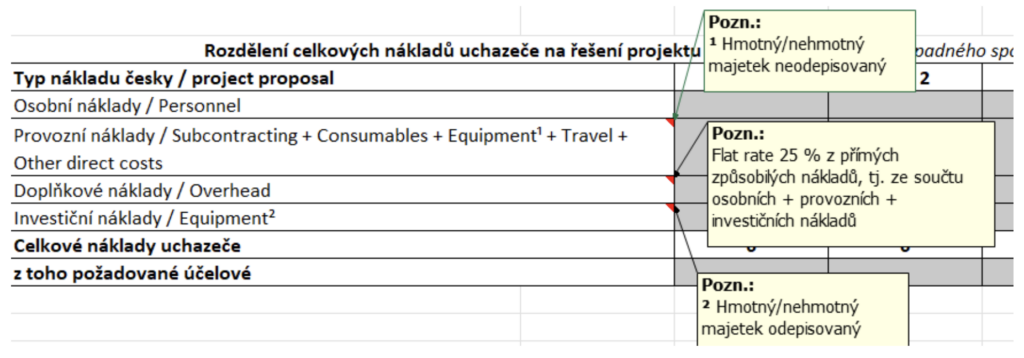 Should these services (sequencing, FedEx shipping, poster printing) be classified under "Subcontracting" or "Other Direct Costs"?How should I correctly classify the various types of expenses (e.g., supplies, small assets, equipment, or services) into categories on the pre-proposal form?
These include consumables, i.e., expenses for items that are routinely consumed within the project (typically during the given year). In the pre-proposal, minor tangible assets of a non-capital nature may also be included here. In the national Application Form, these items fall under the category of operating costs.
In the pre-proposal, this category is designated for investments. If you are purchasing non-capital equipment (e.g., with a price below 80,000 CZK), it will be classified as an operating expense rather than an investment in the national Application Form.
These include, in particular, purchased services.
Transfers between cost categories Budget adjustments are permitted provided that the total funding per project does not exceed the maximum allowed amount. However, project costs must be justifiable and directly related to the project’s subject matter. The justification must then be included in the updated Application Form, which is submitted during the second round of the call. At the same time, the call secretariat and the project consortium coordinator should be informed of these changes, noting that the provider agrees to the increase in the national budget, provided that it is duly justified. The reallocation of funds is permitted and is not subject to any restrictions at the national level with regard to European Partnerships. The amount of eligible costs and the corresponding amount of support provided for the project for the entire duration of the project may not be changed during the project period by more than 50% of the amount of public funding specified in the contract and the grant award, as determined by the provider during the evaluation of the call for project proposals. Budget adjustments are permitted provided that the total funding for a single project does not exceed the maximum allowed amount. However, any changes to the budget under Round 2 must be reported to the call secretariat, the project consortium coordinator, and the national representative.To what extent is it possible to make additional adjustments to the project budget between the pre-proposal and full proposal stages?Is it possible to transfer funds between expense categories?Can the budget in the full proposal be increased to the maximum amount allowed?
The internal rules of the respective organisation respecting Czech laws concerning the purchase of services or subcontracts are sufficient.
Choice of service provider or subcontractorAre there any additional methodologies or recommendations for selecting service providers or subcontractors? Or is it sufficient if the selection complies with the internal rules of our organisation?